
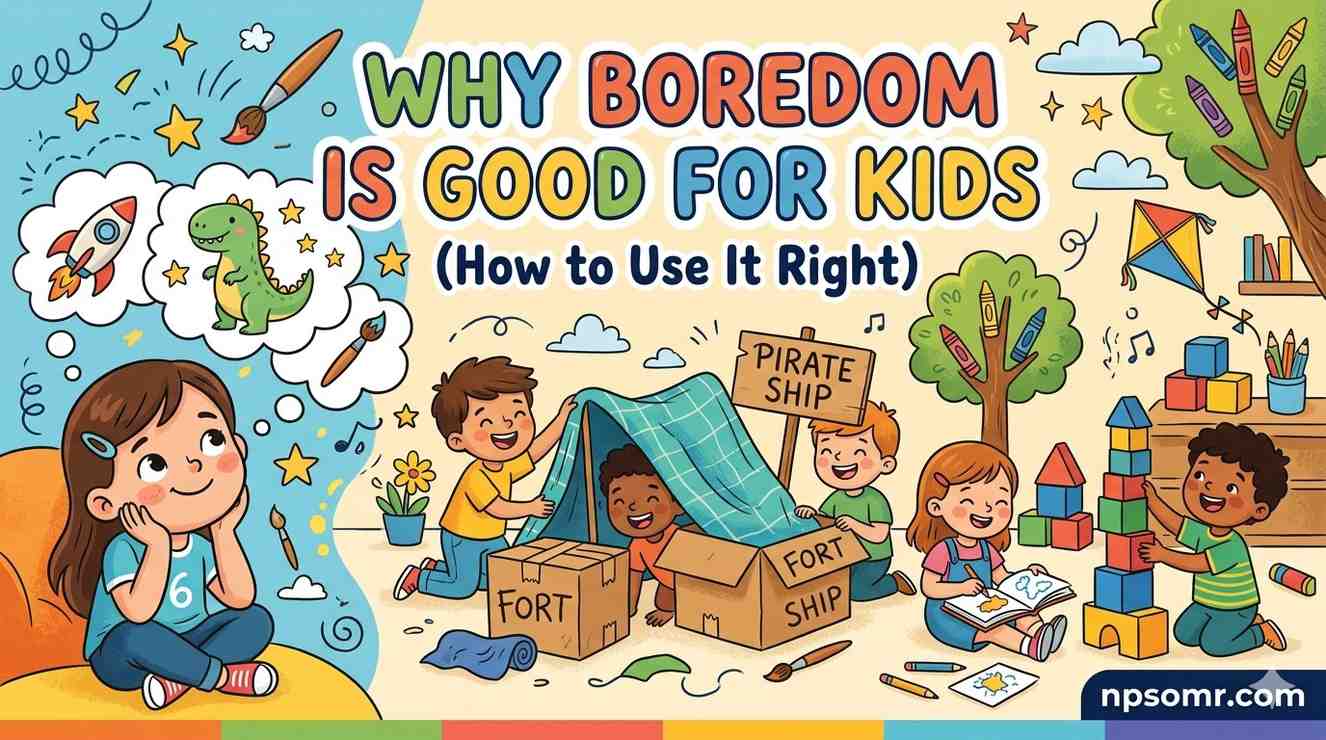
Why Boredom Is Good for Kids (How to Use It Right)
Summer holidays have arrived. You have plans, but how long? Your child keeps running into the room, jumps onto the sofa, and tells the line you’ve heard more than ten times: “I’m bored.”
You’re probably already trying to fix it with a snack, a TV, or an idea. We all do this. It’s instinct. But here’s the one thing that nobody really tells parents: that restless, nothing-to-do feeling your child hates? It might be one of the most useful experiences of their childhood. Not despite the discomfort. Because of it.
What Boredom Actually Does Inside a Child’s Mind
The Discomfort Is Kind of the Point
None of us enjoys being bored. Kids especially. That restlessness — the “ugh, what do I even do” energy — feels like nothing is happening. But neurologically, something very much is.
When there’s no external input driving a child’s attention, the brain doesn’t go idle. It starts doing something far more interesting: it begins generating. It rummages around. Connects things. Wonders. The creativity researchers talk about — the kind that produces original ideas — it doesn’t show up when a child is busy. It shows up when they’re not.
There’s also a resilience piece that gets overlooked. Boredom is mildly uncomfortable. Not painful, not scary — just unpleasant. And navigating that mild unpleasantness, without immediately escaping it, is practice. Real practice, for every frustration that shows up later in the classroom, on the sports field, in friendships. Children who learn to sit with “I don’t like this” and move through it anyway are building something invaluable — long before they know they’re doing it.
Structured Kids, Wobbly Free Time
Here’s a pattern many teachers quietly notice: children who come from extremely packed schedules — lessons after school, activities every weekend, always somewhere to be — sometimes struggle most when given open time. They freeze. They don’t know where to start. Not because they’re less capable, but because they’ve rarely had to start anything themselves.
Planning, initiating, and organizing your own time — those are skills. And like every skill, they need practice. Boredom is where children practice them, messily and imperfectly, in the safest possible environment: at home, with nothing at stake.
The Real Benefits of Boredom Parents Often Miss
It Teaches Kids to Make Decisions
When a child decides to build something out of cardboard scraps, or invent a game with rocks and sticks in the garden, they’re making a hundred small decisions in a row. What to use. How to start. What to do when it breaks. Whether to keep going.
None of that happens when someone else provides the activity. The benefits of boredom here are almost invisible — but they accumulate. Over many afternoons, a child who regularly navigates their own unstructured time becomes noticeably better at organising themselves, breaking tasks into steps, and recovering when things go sideways.
It Does Something Quiet for Self-Esteem
When a child figures out their own boredom — when they pick something, do it, and finish it — they experience a small but significant thing: “I sorted that out myself.” It doesn’t feel big. But repeated enough times, it becomes a quiet, internal belief that they are capable. That they don’t always need someone to come fix things for them.
That belief — grown in boring Tuesday afternoons — carries into the classroom, into friendships, into every situation that asks a child to trust themselves.
“The key is to help kids learn how to manage their boredom so they can develop independence and feel agency over their own happiness.” — Dr. Stephanie Lee, clinical psychologist, Child Mind Institute
How to Use Boredom Right — Without Just Abandoning Them to It
Do the Planning Before the Complaint Arrives
Reactive boredom management is exhausting — for everyone. You’re scrambling, they’re whining, and whatever gets suggested gets rejected. The better move happens before boredom strikes.
Pick a calm moment — not a Saturday-afternoon meltdown — and sit with your child. Ask what they’re into lately. What they’ve always wanted to try but haven’t. What they’d do if they had a whole free afternoon. Write it down together. Make it their list, not yours. Then, when boredom shows up, you point to the list rather than conjuring ideas on the spot. Suddenly, you’re not the entertainment director anymore. And that matters.
What Works for Different Ages
Younger children — roughly 2 to 6 — do best with short, tactile options. Drawing. Dough. Building blocks. Playing with water in the garden. They generally need a gentle nudge toward an activity, but once they’re moving, they go. The goal isn’t a long project; it’s getting them started.
Older children, 7 to 12, can take on something that actually stretches over time. Growing something from a seed. Writing a story one chapter at a time. Using whatever’s in the craft box to build an actual contraption. These longer projects teach planning, patience, and — honestly — how to cope when something you’ve invested in doesn’t go the way you imagined.
When “I’m Bored” Really Means Something Else
Sometimes boredom is a disguise. Children, particularly younger ones, sometimes use it as shorthand for “I want you.” Not stimulation. You. And that’s completely valid. Worth recognizing.
A practical approach: offer two specific choices from their list and say they need to pick one. If every option gets shut down flat, it’s probably a connection moment, not a boredom moment. Give them a short window of real, present attention. Then guide them back. Handled consistently, this also teaches children to ask for what they actually need, which is a skill worth learning early.
Let the Failed Project Sit There
The tower fell. The drawing looks nothing like what they pictured. The game rules don’t work. Every instinct says step in, fix it, smooth it out.
Don’t. Ask a question instead, “What could you try differently?” and then step back. The failed attempt isn’t a detour from the lesson. It is the lesson. Boredom teaching children how to recover, rethink, and try again is one of the most quietly powerful things it does. Let it do that work.
Boredom Isn’t a Problem. It’s a Beginning.
We live in a world that treats empty space as something to be fixed. Every gap becomes an opportunity to schedule, stimulate, or optimise. But children are not productivity projects, and a slow afternoon isn’t wasted time.
The benefits of boredom aren’t obvious. They don’t show up in a report card or a performance review. They show up later in a teenager who can handle setbacks, a young adult who can direct their own time, and a person who trusts that they can figure things out when nobody hands them the answer.
None of that begins in a classroom. A lot of it begins on a boring Saturday, when a child, left to their own devices, discovers they’re more resourceful than they knew.
So next time you hear “I’m bored,” try holding back. Just for a bit. See what they do with it. You might be surprised.