
The Magic of the Solar System: Exploring Our Cosmic Neighborhood
Have you ever looked up at the night sky and wondered what lies beyond those tiny sparkling dots? The universe is vast and full of mysteries, and at the heart of it lies our very own solar system — a magnificent collection of planets, moons, and other celestial wonders that revolve around the Sun. At National Public School, OMR, we encourage students to explore the universe with curiosity and imagination. Let’s take a journey through space and uncover the fascinating story of our solar system.
What Is the Solar System?
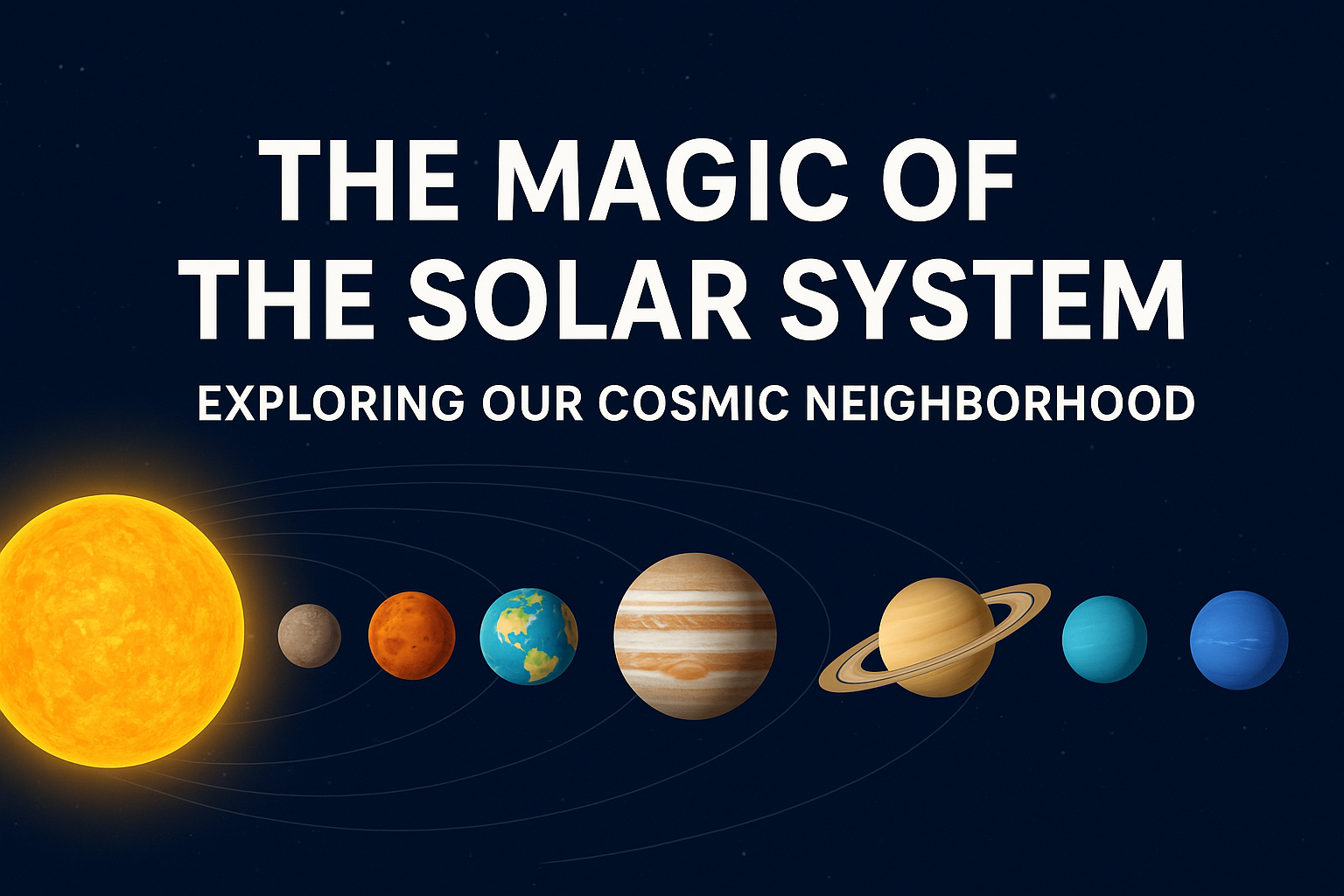
The solar system is like a big cosmic family, with the Sun at its center and eight planets orbiting around it. Along with these planets, the solar system also includes dwarf planets, moons, asteroids, comets, and meteoroids — all held together by the Sun’s strong gravitational pull.
The eight planets are divided into two groups:
-
Inner Planets: Mercury, Venus, Earth, and Mars — small and rocky worlds close to the Sun.
-
Outer Planets: Jupiter, Saturn, Uranus, and Neptune — giant planets made mostly of gas and ice.
Each planet is unique, with its own size, atmosphere, and special features that make it one of a kind.
Meet the Planets
Mercury is the smallest and closest planet to the Sun. Days here are scorching hot, but nights are freezing cold!
Venus, often called Earth’s twin, is covered with thick clouds of acid and has a surface hotter than any other planet.
Earth is our home — the only known planet that supports life, with water, air, and the perfect climate for living beings.
Mars, the Red Planet, has dusty red soil and giant volcanoes. Scientists believe it might have once had water, and future astronauts could one day visit it.
Jupiter is the largest planet, a gas giant with more than 75 moons! Its most famous feature is the Great Red Spot, a giant storm that has been swirling for centuries.
Saturn is known for its beautiful rings made of ice and rock. It’s one of the most visually stunning planets in the solar system.
Uranus spins on its side, making its seasons last for decades. Its bluish color comes from methane gas in its atmosphere.
Neptune, the farthest planet, is a deep blue world with powerful winds — the fastest in the solar system!
Other Members of Our Solar Family
Apart from the planets, the solar system is filled with smaller bodies that are equally fascinating:
-
Dwarf Planets like Pluto remind us that the universe is full of surprises.
-
Asteroids are rocky objects found mainly in the asteroid belt between Mars and Jupiter.
-
Comets are made of ice and dust. When they get close to the Sun, their icy surface turns into a glowing tail — a beautiful sight from Earth!
The Sun: The Heart of the Solar System
At the center of it all is the Sun, a giant ball of hot gases that gives us light, heat, and energy. Without the Sun, there would be no life on Earth. It’s about 4.5 billion years old and still shining bright, making it one of the most important stars in our galaxy.
Exploring Space: The Future Awaits
Humans have always been curious about what lies beyond our planet. From telescopes that look deep into the galaxy to rockets that explore distant worlds, space exploration has helped us learn more about where we come from. Satellites orbit our Earth, astronauts work aboard the International Space Station, and rovers roam Mars, sending us pictures from millions of kilometers away.
At NPS OMR, we inspire students to dream big — perhaps the next space explorer, scientist, or astronaut is already sitting in one of our classrooms!
Learning from the Cosmos
Studying the solar system teaches us not just about space, but about teamwork, curiosity, and discovery. Every planet, every moon, and every asteroid has a story to tell. By exploring them, we also learn more about ourselves — how precious and unique our Earth truly is.
So, the next time you gaze at the stars, remember that you’re part of something much bigger — a cosmic neighborhood full of wonder. Keep asking questions, keep imagining, and keep exploring. The universe is waiting for you to discover its secrets!