
Faculty You Can Trust: Qualifications, Tenure & Teacher Retention at NPS OMR
Walk into any vibrant classroom in NPS OMR, and you immediately sense the energy that defines genuine learning. Dynamic smart panels, well-appointed laboratories, and rich reading corners create an inviting atmosphere, while the daily spark comes directly from the mentor standing before the class. Finding the right academic environment means looking closely at classroom standards, and exploring our National Public School OMR Guide gives families a clear view of campus life. Student confidence grows steadily when qualified educators guide them every day.
Key Takeaways
- Rigorous credentials anchor academic excellence and safety.
- Consistent mentorship builds enduring student confidence.
- High retention ensures reliable curriculum delivery daily.
- Continuous training equips educators with modern skills.
- Specialized educators support diverse classroom learning styles.
Why NPS OMR Teachers’ Qualifications Set a High Standard
Academic rigor begins with strong subject mastery and specialized pedagogical certification. At National Public School Old Madras Road, faculty recruitment focuses on deep academic foundations and communicative warmth. When reviewing CBSE school teachers’ qualifications, families value educators who combine university degrees with recognized teacher training credentials.
Under the academic leadership of Principal Mrs. Hamsalatha R Muthu (holding an MA in History, B.Sc., and B.Ed.), the campus maintains a dedicated team of over forty qualified educators across foundational, primary, and middle school departments. The NPS OMR faculty brings together versatile academic backgrounds:
- Postgraduates holding M.Sc. degrees in Statistics and Life Sciences are leading core STEM classrooms.
- Subject specialists with engineering degrees (B.Tech and B.E.) heading computer science and analytical mathematics.
- Certified Master of Arts (MA) and Master of Education (M.Ed.) scholars anchoring languages and social sciences.
- Early childhood specialists holding certified Pre-Primary, Montessori, and NTT credentials.
- Dedicated support from an RCI-certified Special Educator (M.Sc., B.Ed., PGDEI) and a trained student counselor.
With a healthy teacher-to-student ratio of 1:1.5, mentors give focused attention to individual learners. Meeting the benchmarks for qualified teachers in CBSE schools involves combining foundational degrees with ongoing in-service development.
The True Importance of Experienced Teachers in Schools
Classroom experience brings immediate pattern recognition, steady patience, and intuitive communication. An experienced mentor reads student expressions during a problem-solving session, spotting hesitation before it turns into frustration.
Understanding how teacher experience impacts student learning highlights clear developmental gains:
Early Diagnostic Support and Remediation
Seasoned educators recognize conceptual gaps during class discussions. An experienced teacher adapts lesson explanations, introduces tactile models, and answers spontaneous questions on the spot. Having on-campus specialists in child psychology and learning support ensures every child receives tailored academic pathways.
Stable Classroom Leadership
A predictable, structured environment helps children focus. Teachers who have guided multiple cohorts navigate playground conflicts, peer dynamics, and academic deadlines with calm assurance. This steady atmosphere encourages students to embrace complex challenges.
Balanced Curriculum Implementation
Delivering a rigorous curriculum while encouraging creative curiosity requires practical experience. Exploring our comparison on CBSE or ICSE at NPS OMR explains how our classroom methods balance structured board standards with joyful project work.
Continuous Professional Development: Investing in Faculty Growth
High NPS OMR teachers’ qualifications stay sharp through targeted professional development workshops. Modern classrooms require educators to master evolving digital tools and research-backed teaching methods.
Recent faculty development programs include:
- IFP Training (May 2026): Hands-on modules equipping teachers with advanced Interactive Flat Panel tools to turn daily lectures into visually dynamic, collaborative experiences.
- Higher Order Thinking Skills (HOTs) Training: Pedagogical workshops focused on designing inquiry-led questions, case studies, and evaluative exercises that encourage analytical thinking.
- Pre-Primary (PP) Training: Specialized sessions covering early developmental milestones, play-based phonetics, sensorimotor integration, and positive classroom routines.
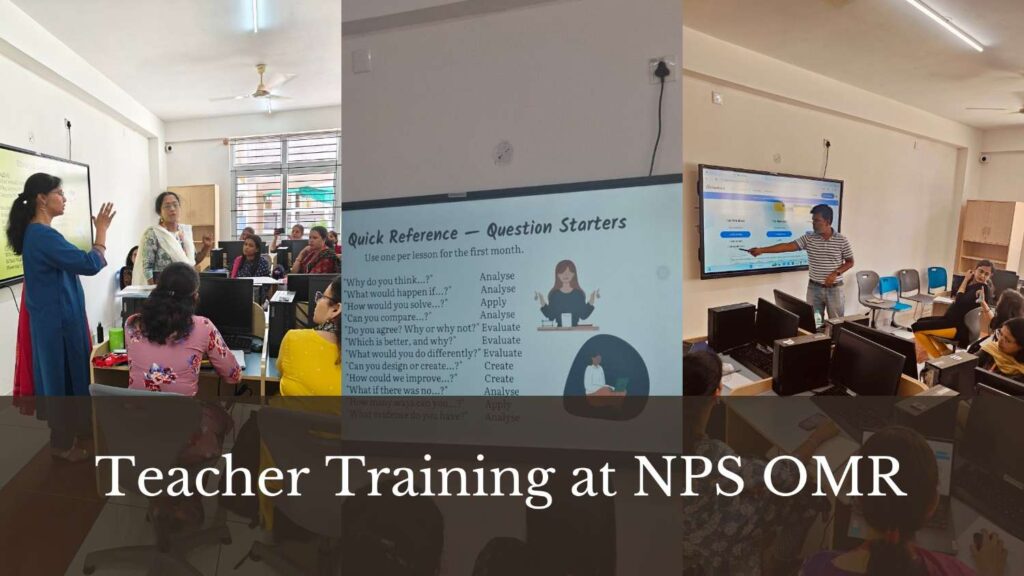
Continuous training ensures that qualified teachers in CBSE schools bring fresh teaching strategies into their classrooms every semester.
Why Teacher Retention in Schools Defines Campus Culture
A stable faculty team creates a cohesive learning community. When educators stay with an institution over many years, they build deep institutional wisdom, refine school traditions, and develop enduring connections with families. The importance of experienced teachers in schools shines when younger siblings enter classrooms led by teachers who already understand their strengths.
Institutions promote teacher retention in schools through systematic support:
- Classroom Autonomy: Educators have room to introduce creative experiments, interactive projects, and original teaching aids.
- Supportive Infrastructure: Modern digital displays, specialized laboratories, and comprehensive resource materials streamline lesson preparation.
- Collaborative Peer Culture: Regular interdepartmental planning meetings encourage teachers to share successful methods and mentor newer colleagues.
- Wellness and Professional Respect: Dedicated planning periods and clear recognition programs prevent burnout and sustain daily enthusiasm.
Maintaining strong teacher retention in schools gives learners the security of familiar, trusted faces throughout their educational journey.
Daily Mentorship Across Academic Stages
Every stage of school life benefits from tailored pedagogical guidance:
Foundational Years: Sensory Discovery and Structure
Pre-primary educators utilize Montessori and early-years certifications to make early numeracy and literacy intuitive. Play-based group activities build foundational communication skills.
Middle School: Inquiry and Analytical Rigor
Middle school subject specialists guide students through abstract mathematics, laboratory investigations, and language comprehension. Teachers apply HOTs methodologies to encourage debate and structured reasoning.
Holistic Development: Creative Arts and Physical Health
Qualified Physical Education instructors (holding B.PEd and M.PEd degrees), Fine Arts specialists (BFA), and performing arts mentors nurture creativity and physical wellness. To understand how our campus ethos stands out across the city, exploring NPS OMR vs other CBSE schools in Bangalore provides a valuable perspective on holistic school development.
Fostering Lifelong Curiosity Through Stable Leadership
Great learning environments thrive on the daily commitment of enthusiastic educators. When schools prioritize comprehensive CBSE school teachers qualifications, regular skill workshops, and long-term retention, classrooms become inspiring centers of growth. Our dedicated NPS OMR faculty provides the steady guidance that helps every student flourish academically and personally.
Book a visit to NPS OMR.
FAQs
What is the teacher-student focus like in the classroom?
We keep things highly personalized with a teacher-to-student ratio of 1:1.5. This focused setup allows our core team of 41 teachers to genuinely understand, mentor, and guide each child on campus.
What kind of degrees do the educators hold?
Academic depth matters immensely. Our faculty members bring strong university credentials to the table, including MA, M.Sc, B.Tech, and B.Ed degrees across various specializations. Leading the academic vision is our Principal, Mrs. Hamsalatha R Muthu, who holds a B.Sc., B.Ed., and an MA in History.
Is there support for diverse learning styles and emotional wellness?
Navigating school life requires more than just subject instruction. We have a dedicated special educator on staff to support unique academic learning requirements. Furthermore, a certified student counselor is available on campus to focus entirely on mental and emotional well-being.
Are the educators trained to handle modern classroom tools?
Beyond holding core CBSE school teacher qualifications, continuous professional upskilling happens regularly. Our staff recently underwent targeted Interactive Flat Panel (IFP) training in May 2026 to maximize digital classroom tools. They also participate in Higher Order Thinking Skills (HOTS) and specific Pre-Primary (PP) training to keep daily lessons vibrant.
How is the teaching staff distributed across grade levels?
Our comprehensive roster of 41 teaching professionals covers all educational stages. This includes 18 Primary Teachers (PRT) handling the foundational years and 8 Trained Graduate Teachers (TGT) guiding our middle school cohorts through complex subjects.