
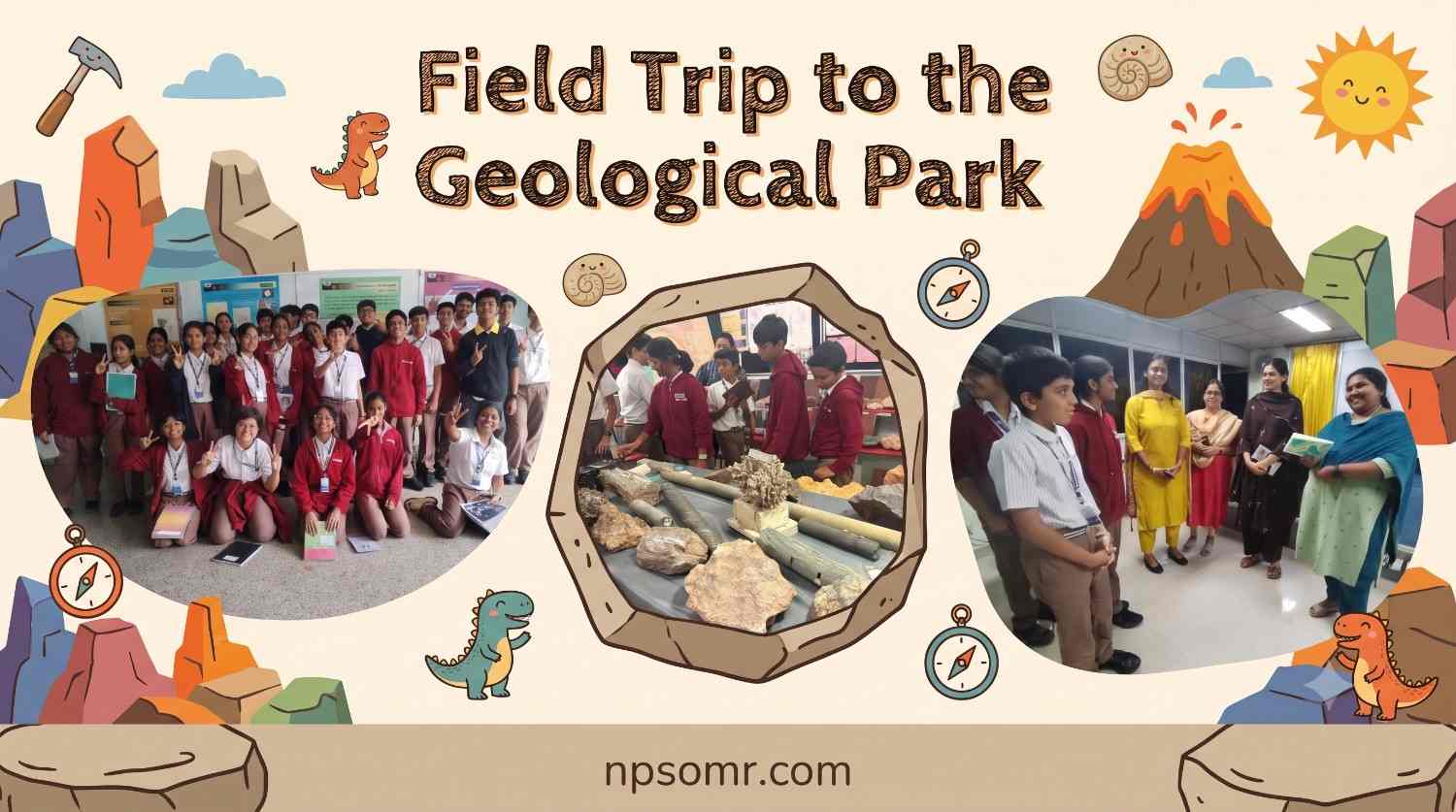
Field Trip to the Geological Park
Grade 8 students visited a geological park, examining rock formations, minerals, and fossils up close as part of their ongoing study of earth science. The trip turned concepts like weathering, erosion, and the rock cycle into something students could see and touch, set against a real, physical landscape shaped over millions of years.
Guides walked students through how to “read” a rock formation identifying layers, textures, and colours that hint at how each formation was created. Students learned to distinguish between igneous, sedimentary, and metamorphic rocks, connecting each type to the specific geological process that formed it, whether volcanic activity, sediment build-up, or intense heat and pressure underground.
The visit covered a wide range of hands-on learning:
- Rock and mineral samples, examined for texture, hardness, and composition
- Visible weathering and erosion, seen in cracked, layered, or smoothed rock surfaces
- Fossil impressions, where available, offering a glimpse into much older forms of life
- The rock cycle in action, tracing how one rock type can slowly transform into another over geological time
- Basic field techniques, including simple observation, sketching, and note-taking methods used by geologists
Earth science can feel abstract when confined to diagrams and timelines on a page. Standing in front of rock formations that have taken thousands or millions of years to form gave students a genuine sense of scale, both in terms of time and geological processes that is difficult to convey indoors. Questions about how mountains form, why some rocks are smooth while others are jagged, and how fossils get preserved all found tangible answers on site.
Students were encouraged to examine a rock formation and reason out loud about what process might have shaped it, rather than simply being told the answer an approach that mirrors how geologists actually work in the field.
The visit also connected naturally to the region’s own geological character. Karnataka is home to some of the oldest rock formations in the country, including striking granite landscapes shaped over vast stretches of geological time. This gave students a meaningful local context for concepts that are often taught using examples from far-off places.
For Grade 8 students preparing for more advanced science study, this field trip offered something no diagram can fully replace: direct, physical evidence of processes that shape our planet over unimaginable timescales. It is this kind of first-hand exploration that turns earth science from a set of facts to memorise into a subject worth genuinely understanding.