
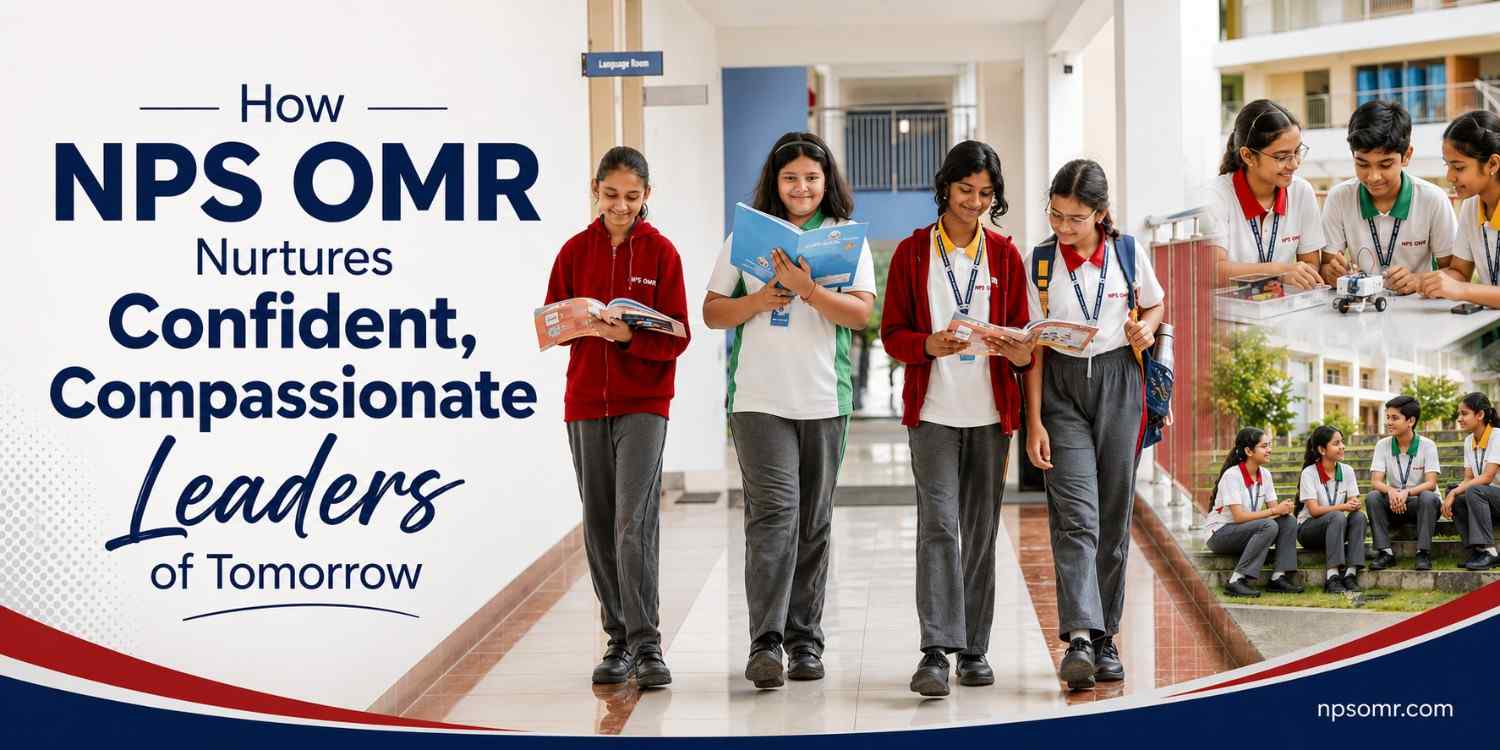
How NPS OMR Nurtures Confident, Compassionate Leaders of Tomorrow
Leadership isn’t a subject on a timetable. At National Public School, Old Madras Road (NPS OMR) in Bengaluru, it’s built into daily school life through structured responsibility, real decision-making opportunities, and a values framework students live by, not just read about. From a kindergartner learning to share and take turns, to a senior student chairing a council meeting, NPS OMR treats leadership as a skill built in stages, not a trait some children are simply born with.
Here’s how that plays out across the school year, and what it means for your child’s student development.
Why Leadership Skills Matter for Every Student Today
Leadership skills give children more than a title or a badge. They shape how a child handles conflict, makes decisions, and works with others skills that matter far beyond the school gate. Students who get real opportunities to lead tend to show:
- Stronger self-confidence, from taking on visible responsibility
- Better decision-making, from practising it in low-stakes settings
- Improved communication, from speaking up in groups and representing peers
- Greater emotional intelligence, from learning to read and manage group dynamics
- A head start on career readiness, since employers and universities increasingly look for these exact soft skills
The challenge for most schools is moving past posters and pep talks into structures that actually hand students responsibility. That’s where a school’s day-to-day design matters more than its mission statement.
How NPS OMR Builds Leadership from Kindergarten Up
NPS OMR doesn’t wait until Grade 11 to talk about leadership. The school stages leadership exposure across every level, so that by the time a student reaches senior school, taking charge feels familiar rather than intimidating.
Early Years: Planting the Seeds of Confidence
Kindergarten at NPS OMR is play-based by design. Structured play, group activities, and guided social interaction give even the youngest learners early practice in sharing, turn-taking, and expressing themselves the foundation every future leader needs.
Middle School: Taking On Real Responsibility
As students move into middle school, the curriculum shifts toward preparing them for the greater academic and social demands of high school. This is typically where students start taking on classroom responsibilities, contributing to group projects, and building the habits of accountability that leadership roles later depend on.
High School: Advanced Leadership and College Readiness
By high school, students at NPS OMR have access to more advanced coursework alongside college counselling and formal leadership opportunities, including a seat on the Student Council, one of the most visible leadership roles in the school.
Inside the Investiture Ceremony, NPS OMR’s Signature Ritual
If one event captures how NPS OMR approaches leadership, it’s the Investiture Ceremony — the formal appointment of the Student Council for the academic year.
At the 2026 ceremony, held in the School Atrium, students who had shown strong character, commitment, and leadership potential took the oath of office and received their badges of responsibility in front of the school community. The event was attended by guests from outside the school gates, including entrepreneurs and industry professionals, underlining that the skills being recognised- responsibility, integrity, and service- matter well beyond the classroom.
The ceremony is built around two guiding ideas the school returns to often:
- Empower, Entrust, Inspire: how the school approaches its student leaders
- Lead, Serve, Excel: what it expects from them in return
This is not a symbolic photo opportunity. Council members take on real duties for the rest of the academic year, giving them sustained practice in leadership rather than a single day in the spotlight a good example of what NPS OMR student leadership programs look like in practice.
Beyond the Classroom (Clubs, Sports and Co-Scholastics)
Leadership at NPS OMR isn’t confined to the Student Council. The school describes its approach to student life as “holistic development beyond academics,” built around four pillars: sports, clubs, arts, and events.
With a 1:15 student-teacher ratio, teachers are positioned to notice individual strengths early, whether a child gravitates toward the debate club, a sports team, or the school band, and to hand them small leadership moments accordingly: captaining a match, leading a rehearsal, organising an event. These lower-stakes, frequent opportunities matter because they normalise leadership as something any student can practise, not just the students formally elected to office. This is what NPS OMR extracurricular activities are designed to do: turn interest into initiative.
Life Skills That Extend Beyond the School Gate
Life skills education and leadership development overlap more than most parents realise. Managing a group project teaches negotiation. Representing classmates’ concerns to a teacher teaches diplomacy. Losing an election and still showing up to support the winner teaches resilience.
Many CBSE schools, NPS OMR included, are shifting classroom practice to reflect the National Education Policy’s broader emphasis on experiential, competency-based learning rather than rote instruction alone. In practice, that means more group work, more student voice in classroom decisions, and more chances to fail safely and try again, which is, ultimately, how leadership is actually learned.
Holistic Education: Balancing Academics and Character
NPS OMR emphasizes that every child has unique strengths and does not follow a one-size-fits-all approach to learning. The school’s stated aim is to identify and nurture a child’s natural strengths artistic, analytical, scientific, or linguistic rather than force a single specialisation. That philosophy sits behind the school’s motto: Reach Out, Reach High, Reach Beyond.
It’s also worth noting the scale behind that promise. NPS OMR is part of the wider National Public School Group, which has built more than 60 years of educational experience across 18+ branches in India. A newer campus inherits a well-tested academic and co-scholastic framework, rather than building one from scratch — which matters for parents assessing how much to trust a growing school’s claims about character development in schools.
How Parents Can Reinforce Leadership at Home
Schools can only do so much in six hours a day. A few ways parents can carry the same habits home:
- Hand over small, real decisions: what the family cooks on a weekend, how a shared chore gets divided, rather than always deciding for your child.
- Ask reflective questions after school activities: “What was hard about that?” builds more self-awareness than “How did it go?”
- Praise effort and judgment, not just outcomes: A child who made a fair call in a disagreement deserves as much credit as one who won a competition.
- Model calm conflict resolution: children copy how the adults around them handle disagreement far more than they follow advice about it.
Ready to See It in Person?
The best way to understand how leadership development actually works at NPS OMR is to see the campus and meet the team. Visit the admissions page to learn about the current registration cycle, or explore co-scholastic programmes and student life for a fuller picture of what your child’s week could look like
FAQs
At what age does NPS OMR start leadership training?
Leadership groundwork begins in Kindergarten through play-based social learning, and builds in complexity through middle and high school, culminating in formal roles like the Student Council.
What happens at the NPS OMR Investiture Ceremony?
It’s the formal appointment of the Student Council for the academic year. Selected students take an oath of office and receive badges of responsibility in a school-wide ceremony, often attended by outside guests, before taking up real duties for the rest of the year.
Does NPS OMR follow NEP 2020?
As a CBSE-affiliated school, NPS OMR’s curriculum reflects the broader shift toward NEP-aligned, competency-based learning that CBSE schools nationally have been adopting.
How can parents get involved in student leadership initiatives?
NPS OMR runs periodic parent orientation sessions, giving families visibility into school programmes and a channel to raise ideas or feedback directly with the school.