
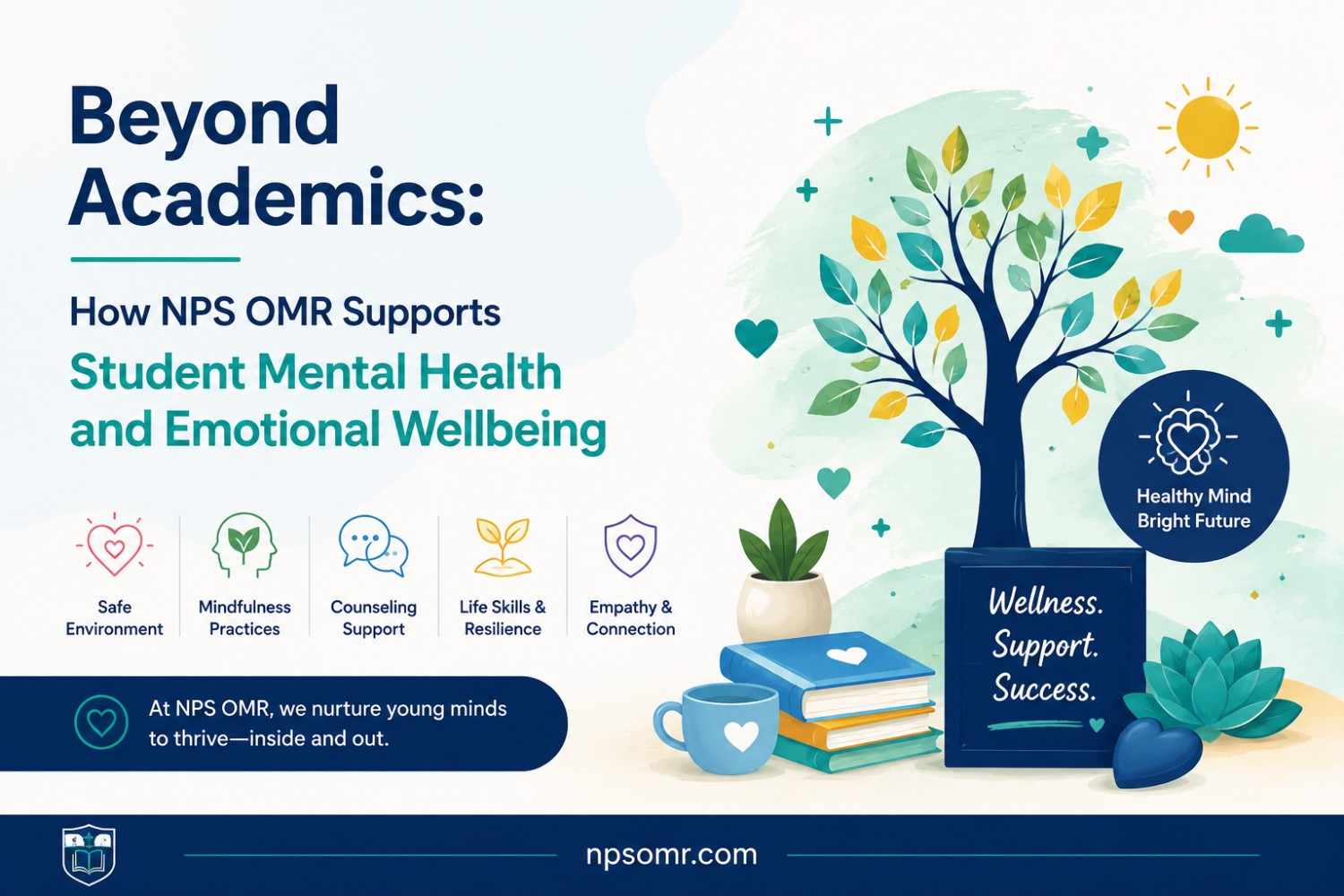
Beyond Academics: How NPS OMR Supports Student Mental Health and Emotional Wellbeing
A good school report card was never the whole story. NPS OMR supports student mental health through a trained counselling framework, everyday social-emotional learning, a low 1:15 student-teacher ratio, and wellness practices that run alongside, not after, the academic day, in step with CBSE’s 2025–26 mental health mandate. Here’s what that actually looks like at the OMR campus.
Why Student Mental Health Matters in Every CBSE School
Indian students today carry more than homework. Board-pattern exams start earlier. Phones and social media never switch off. Comparison with classmates is constant. Left unaddressed, this pressure shows up as anxiety, sleep loss, and a shaky sense of self-worth right when a child needs to be building both.
The country has taken notice. In July 2025, the Supreme Court directed schools to build formal mental health support into daily operations, not treat it as an occasional add-on. CBSE followed with fresh circulars through August 2025, introducing a Counselling Hub-and-Spoke model that pairs experienced “hub” schools with others still building their systems. Twice-yearly staff training on mental health and social-emotional learning (SEL) is now expected of every affiliated school.
At NPS OMR, this isn’t a policy to react to. It’s an extension of how the school already talks about its students: not as ranks and percentiles, but as young people whose “natural abilities, be it artistic, analytical, scientific, or linguistic,” deserve room to grow.
How NPS OMR Supports Student Mental Health Daily
Counselling and Emotional Support at NPS OMR
NPS OMR has a qualified school counsellor available to students, meeting CBSE’s requirement that every affiliated school with 100 or more students appoint at least one. Students can ask for a confidential conversation directly or through their class teacher, and the counsellor works alongside teachers and parents so support doesn’t stop at the door of one office; it follows through into the classroom and home.
Life Skills and Social-Emotional Learning in Class
NPS OMR builds reflection into the school day itself. Classrooms are designed around inquiry-based learning, reflective journaling, group projects, and open discussion formats that naturally give students practice at managing emotions, disagreeing respectfully, and asking for help. This is social-emotional learning happening inside the curriculum, not bolted onto it.
The school also builds in moments that name the emotional side of school life directly. At its Let’s Shine Together event, marking the close of the academic year, students thanked their teachers in age-appropriate, creative ways for the support that usually goes unspoken — turning what could be a routine send-off into a deliberate exercise in gratitude, kindness, and recognising the emotional bond in a classroom, not just the academic one.
A 1:15 Student-Teacher Ratio That Enables Attention
A child who’s struggling rarely announces it. A teacher who knows thirty-five names well enough to notice a change in one of them is a form of mental health support in itself. NPS OMR maintains a 1:15 student-teacher ratio, offering closer attention than most large CBSE schools can offer, which is part of why the school was recognised as Emerging CBSE School of the Year 2025 for Excellence in Value-Based Education.
Mindfulness and Stress-Relief Practices
NPS OMR builds structured mindfulness, breathing, and movement breaks into the school week. On International Yoga Day, for instance, Pre-Primary students practised breathing exercises alongside yoga poses: Tree Pose, Cat & Cow, Cobra, Starfish, Dolphin, building balance, focus, flexibility, and mindfulness in a format young children can actually stick with, rather than a one-off assembly demonstration.
Emotional Wellbeing Programs at NPS OMR Beyond Class
Sports, Arts, and Co-Scholastic Programmes
Wellbeing isn’t only a counselling-room conversation. It’s also what happens on a football field or in a music room. NPS OMR’s co-scholastic programmes give students a regular outlet for stress that has nothing to do with a test. The school’s football team, for instance, finished runners-up at the East Bangalore School Interschool Football Competition, with individual players recognised too, the kind of shared, low-stakes win that builds belonging.
Samanvaya: Annual Day and a Sense of Belonging
Samanvaya, NPS OMR’s Annual Day celebration for the 2025–26 academic year, brought the whole school together around student performances rather than test scores. Occasions like this matter because isolation, more than difficulty itself, is often what turns ordinary stress into something heavier. A shared stage, in front of family and classmates, is a concrete, once-a-year reminder to every child that they’re part of something bigger than their own report card.
Parent Workshops and Open Communication
CBSE’s newer guidelines specifically ask schools to help parents recognise emotional distress early and avoid piling on academic pressure at home. NPS OMR’s Parent Orientation Programme, held for families of newly admitted students across Pre-Primary, Primary, and Middle School, walks parents through the school’s approach to discipline, creativity, and experiential learning, and importantly, the support systems available for students, with an open question-and-answer session rather than a one-way briefing. Regular parent-teacher touchpoints keep that conversation going rather than limiting it to report-card day.
NPS OMR’s Alignment with CBSE’s 2025–26 Wellness Mandate
Twice-Yearly Capacity Building for Teachers and Staff
As a CBSE-affiliated school, NPS OMR falls under CBSE’s August 2025 mandate: twice-yearly, six-hour staff training on mental health and wellness and on social-emotional learning, covering psychological first aid and how to recognise early warning signs. This is a compliance floor CBSE has set for every affiliated school, not an optional extra, so it’s a baseline any parent can expect the school to meet, and it sits on top of a training calendar NPS OMR already runs: new-teacher induction, workshops on inclusive teaching and higher-order thinking skills, and communication training rather than a first attempt at structured staff development.
Stress Management for Students: Tools NPS OMR Teaches
Some of the most useful stress-management tools are also the simplest. Practices that show up across well-run CBSE schools and that NPS OMR can reasonably build on include:
- Three-line journaling: writing down what went well, what was hard, and what still feels unsettled, to externalise worry instead of carrying it silently.
- Structured breathing: a slow inhale-hold-exhale pattern before an exam or a stressful moment, to calm the body’s stress response in minutes.
- Movement breaks: even a short walk between classes measurably lowers stress hormones.
- Continuous assessment over last-minute pressure: spreading evaluation across the term, rather than stacking it into one high-stakes exam, reduces the spike of exam-week anxiety.
Raising Confident Students, Not Just High Scorers
A school report card measures one part of a child. NPS OMR’s approach smaller classes, a curriculum built around reflection, and a wellness framework- is catching up fast with CBSE’s newest mandate and aims at the rest: the part that shows up as confidence, resilience, and a kid who’s genuinely glad to come to school on a Monday.
Want to see it for yourself? Book a school visit.
FAQs
What wellness programs does NPS OMR offer students?
NPS OMR combines everyday social-emotional learning in the classroom, co-scholastic activities like sports and the arts, whole-school occasions like the Samanvaya Annual Day, and parent-orientation programmes, all sitting alongside its 1:15 student-teacher ratio for closer day-to-day attention.
How does NPS OMR help students manage exam stress?
The school’s own student blog tracks this closely, with posts like 15 Ways to Prevent Burnout During Exam Season covering structured study planning, the Pomodoro technique, sleep, and mindfulness. That’s paired with continuous, reflection-based classroom work rather than pressure concentrated into one exam window, and the closer attention a 1:15 ratio makes possible — catching stress early rather than only in exam week.
What mental health support is available at NPS OMR?
NPS OMR has a qualified school counsellor available to students, in line with CBSE’s requirement for schools with 100+ students. Students can request a confidential conversation directly or through their class teacher, and the counsellor coordinates with teachers and parents to keep support consistent beyond a single meeting.
Is NPS OMR among the best CBSE schools for wellbeing in Bangalore?
NPS OMR, on Old Madras Road in East Bengaluru, was recognised as Emerging CBSE School of the Year 2025 for Excellence in Value-Based Education, and structures its 1:15 ratio, co-scholastic programming, and parent engagement specifically around whole-child development rather than academics alone a strong marker for families comparing CBSE schools on wellbeing in Bangalore.