
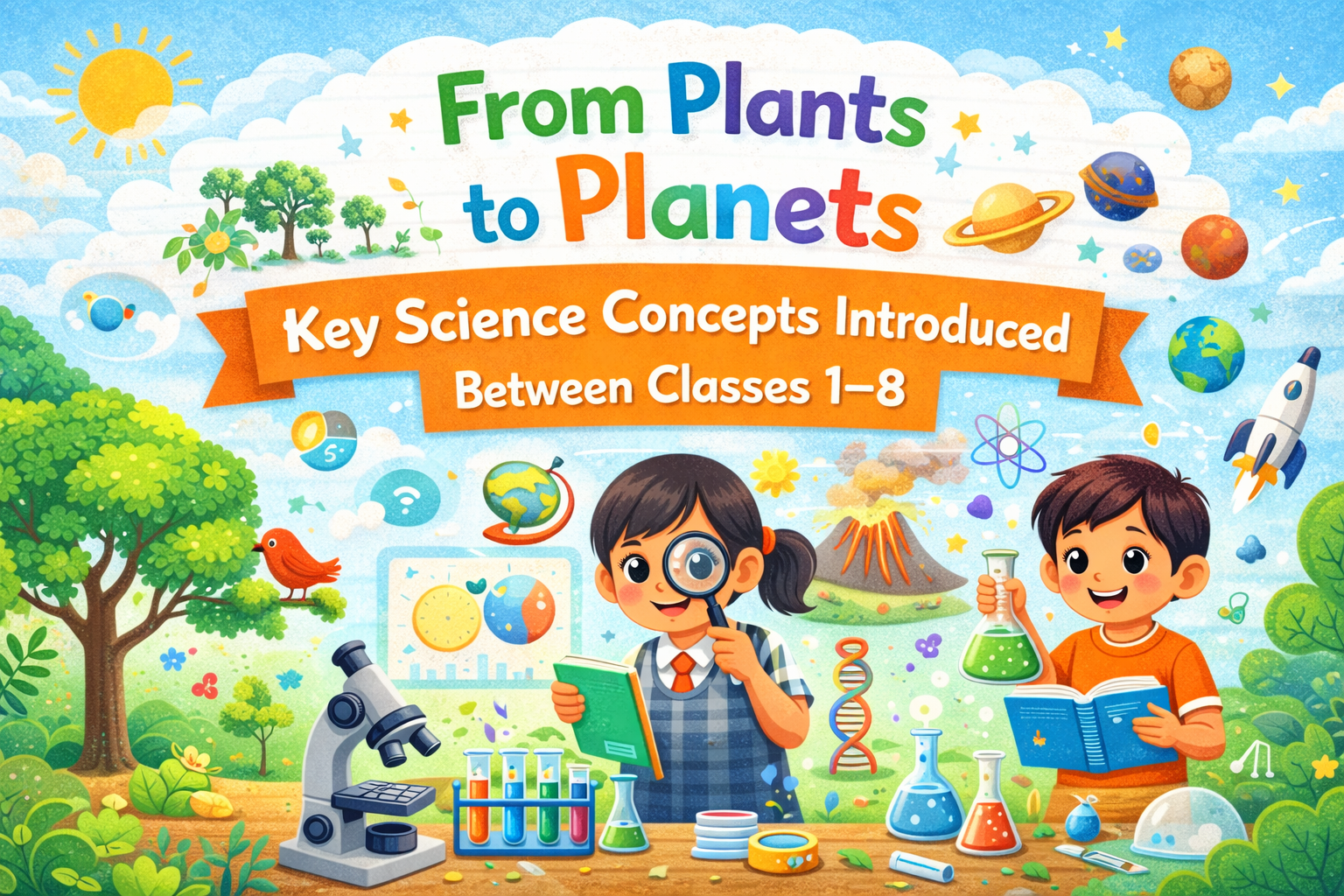
From Plants to Planets: Key Science Concepts Introduced Between Classes 1–8
Science education from Classes 1 to 8 lays the foundation for how students understand the natural and physical world. During these formative years, children move from simple observations of their surroundings to exploring complex scientific ideas. The gradual introduction of concepts helps students build curiosity, reasoning skills, and a lifelong interest in science.
Early Exploration in Primary Classes (Classes 1–2)
In the early primary years, science learning focuses on observation and awareness. Students are introduced to basic concepts that help them understand their immediate environment.
Key topics include:
-
Living and non-living things
-
Plants and animals around us
-
Parts of the body and basic health habits
-
Day and night, sun and moon
-
Simple weather changes
These topics encourage children to observe, ask questions, and relate science to everyday experiences.
Building Understanding in Classes 3–5
As students move into Classes 3 to 5, science becomes more structured and detailed. Concepts are introduced with greater depth, helping students understand how and why things happen.
Important concepts covered during this stage include:
-
Life cycles of plants and animals
-
Food chains and habitats
-
States of matter and changes
-
Light, sound, and simple machines
-
Water cycle and natural resources
Hands-on activities, experiments, and projects help students strengthen their scientific thinking and curiosity.
Expanding Scientific Knowledge in Middle School (Classes 6–8)
In Classes 6 to 8, science is divided into Physics, Chemistry, and Biology, allowing students to explore each branch in detail. Learning becomes more analytical, and students begin applying logic and reasoning.
Key concepts introduced include:
-
Cell structure and body systems
-
Force, motion, and energy
-
Acids, bases, and chemical changes
-
Earth’s structure and natural phenomena
-
Solar system, planets, and space science
At this stage, students learn to connect scientific concepts with real-world applications, strengthening their problem-solving skills.
Importance of Practical Learning
Across all classes, practical learning plays a vital role in science education. Experiments, observations, and models help students:
-
Understand concepts clearly
-
Develop curiosity and creativity
-
Learn through trial and error
-
Apply theoretical knowledge practically
Laboratory activities and classroom demonstrations make science engaging and meaningful.
Encouraging Curiosity and Inquiry
Science education between Classes 1 and 8 is designed to encourage curiosity. Students are motivated to:
-
Ask questions and explore answers
-
Observe patterns and changes
-
Draw conclusions based on evidence
-
Think critically and logically
This inquiry-based approach helps students develop a scientific mindset rather than memorising facts.
Supporting Science Learning at Home
Parents can support science learning by:
-
Encouraging observation of nature
-
Discussing scientific ideas in daily life
-
Watching educational science programmes
-
Supporting school projects and experiments
A positive learning environment at home complements classroom learning.
Conclusion
From understanding plants in early classes to exploring planets and space in middle school, science education from Classes 1 to 8 offers a well-rounded learning journey. These years are crucial in building strong scientific foundations, curiosity, and critical thinking skills. By introducing concepts gradually and meaningfully, students are well-prepared for advanced science learning in higher classes and beyond.