
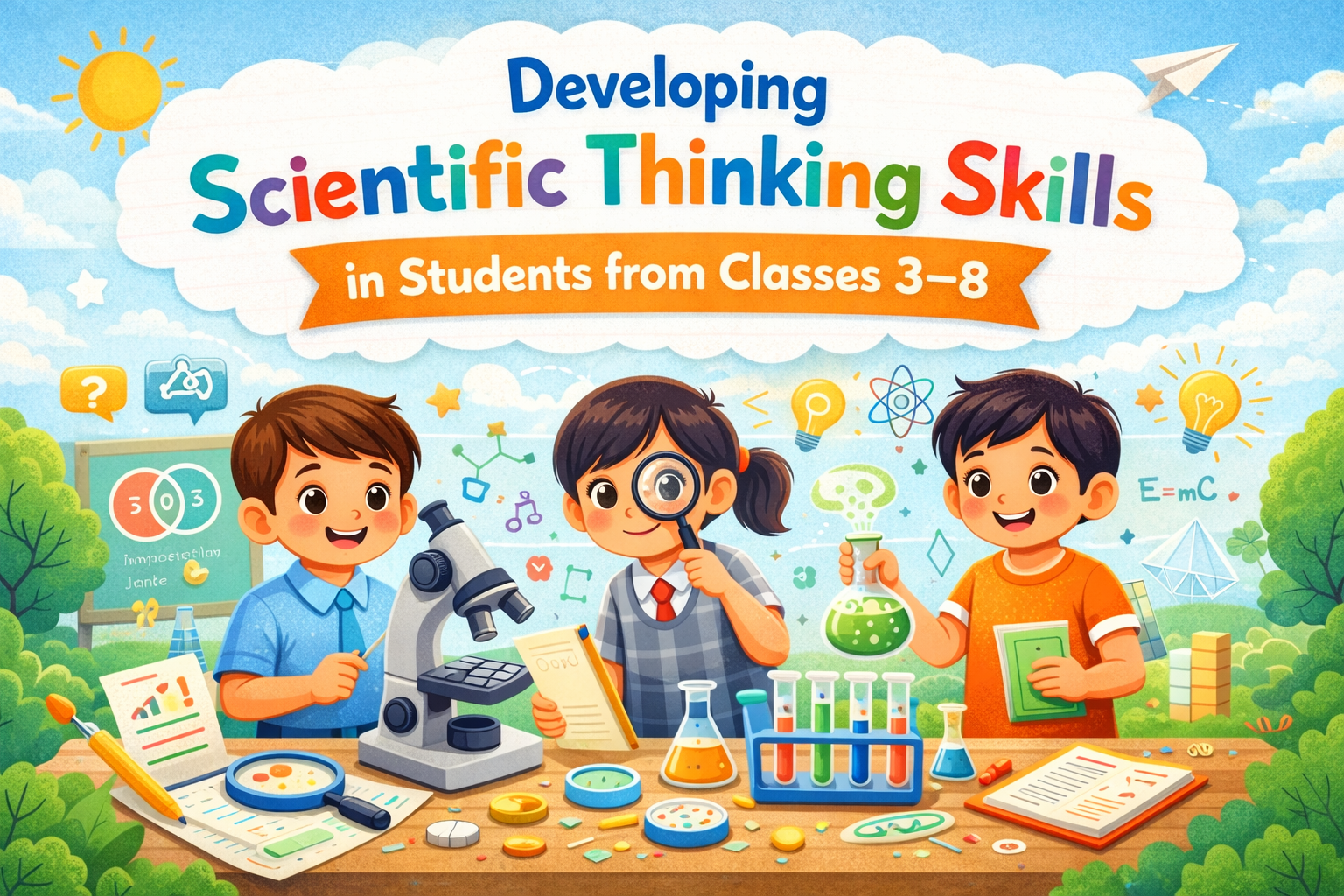
Developing Scientific Thinking Skills in Students from Classes 3–8
Science education in the middle school years plays a crucial role in shaping how students observe, question, and understand the world around them. From Classes 3 to 8, students move beyond learning facts to developing scientific thinking skills—the ability to analyse information, ask meaningful questions, and apply logical reasoning.
What Are Scientific Thinking Skills?
Scientific thinking involves more than conducting experiments. It includes:
-
Observing carefully and accurately
-
Asking questions and forming hypotheses
-
Analysing data and identifying patterns
-
Drawing conclusions based on evidence
-
Applying concepts to real-life situations
These skills help students become independent learners and critical thinkers.
Building Curiosity in Early Middle School (Classes 3–5)
In Classes 3 to 5, science learning focuses on nurturing curiosity. Students explore topics such as plants, animals, materials, light, and basic environmental science. At this stage, scientific thinking is developed by encouraging students to:
-
Observe natural phenomena
-
Record findings through drawings and simple notes
-
Predict outcomes before experiments
-
Discuss observations with peers
Hands-on activities and simple experiments help students understand that science is about exploration, not memorisation.
Strengthening Reasoning Skills in Classes 6–8
As students progress to Classes 6–8, science becomes more structured and analytical. Topics such as physics, chemistry, biology, and earth science require deeper reasoning and logical connections.
Students are guided to:
-
Design and conduct experiments
-
Collect and interpret data
-
Use scientific terminology accurately
-
Understand cause-and-effect relationships
This stage helps students shift from what happens to why it happens, strengthening their analytical abilities.
Role of Experiments and Practical Learning
Practical learning plays a vital role in developing scientific thinking. Laboratory work and classroom experiments allow students to:
-
Test ideas through observation and evidence
-
Learn from mistakes and unexpected results
-
Understand scientific concepts more clearly
Experiments also teach patience, precision, and systematic thinking—skills that are valuable across subjects.
Encouraging Inquiry-Based Learning
Inquiry-based learning encourages students to ask questions and seek answers independently. Teachers support this approach by:
-
Asking open-ended questions
-
Encouraging group discussions
-
Allowing students to explain their reasoning
-
Promoting multiple ways to approach a problem
This method helps students develop confidence in expressing ideas and thinking critically.
Connecting Science to Everyday Life
Relating scientific concepts to daily experiences makes learning meaningful. When students see how science applies to weather, food, health, or technology, they become more engaged and curious.
Real-life connections help students:
-
Retain concepts more effectively
-
Understand the relevance of science
-
Develop problem-solving skills
Supporting Scientific Thinking at Home
Parents can reinforce scientific thinking by:
-
Encouraging children to ask questions
-
Discussing everyday observations
-
Watching educational science programmes together
-
Allowing children to explore safely through experiments and projects
A supportive environment at home strengthens the learning that happens in school.
Conclusion
Developing scientific thinking skills from Classes 3–8 prepares students for advanced learning and real-world problem-solving. Through observation, experimentation, inquiry, and logical reasoning, students learn to think like scientists. This foundation not only supports academic success but also fosters curiosity, creativity, and a lifelong interest in learning.