
Building Number Sense in Primary Classes: How Students Learn Maths from Class 1 Onwards
Mathematics learning in the early years is not about memorising tables or solving long sums. At the primary level, the foundation of all mathematical understanding lies in number sense. From Class 1 onwards, students gradually develop an intuitive understanding of numbers—what they mean, how they relate to one another, and how they are used in everyday situations.
What Is Number Sense?
Number sense refers to a child’s ability to:
-
Understand numbers and their values
-
Recognise number patterns and relationships
-
Perform basic operations with confidence
-
Estimate, compare, and reason logically
Instead of seeing numbers as symbols on paper, children with strong number sense understand what numbers represent and how they work together.
Number Sense Development in Class 1
In Class 1, mathematics focuses on familiarity and comfort with numbers. At this stage, students learn to:
-
Count objects and numbers in sequence
-
Recognise numbers and write them correctly
-
Compare quantities using concepts like more, less, and equal
-
Understand basic addition and subtraction through real-life examples
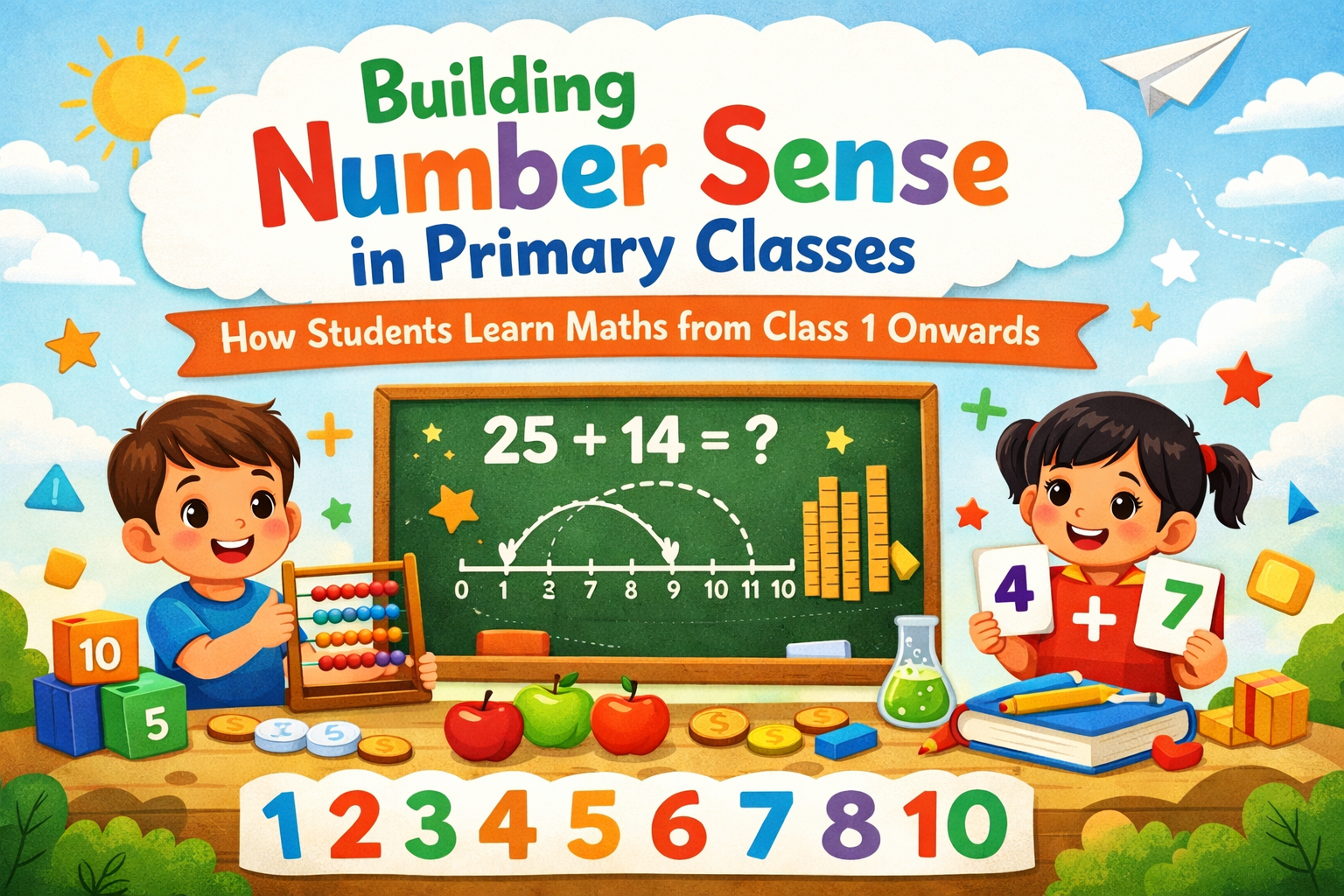
Learning is often activity-based. Using objects such as beads, blocks, fingers, and pictures helps children connect numbers to physical quantities. This concrete approach ensures that maths feels meaningful rather than abstract.
Strengthening Understanding in Class 2
As students move to Class 2, number sense becomes more structured. Children begin to:
-
Understand place value (ones and tens)
-
Add and subtract larger numbers
-
Identify number patterns and sequences
-
Apply maths concepts to simple word problems
At this stage, visual aids like number lines, charts, and grouping methods play a key role. Students learn that numbers are not isolated but part of a system, helping them develop logical thinking.
Expanding Skills in Class 3 and Beyond
By Class 3, students start working with:
-
Three-digit numbers and expanded forms
-
Carrying and borrowing in addition and subtraction
-
Introduction to multiplication as repeated addition
-
Mental maths strategies for faster calculations
Here, the focus shifts from only understanding numbers to using them flexibly. Students are encouraged to explain how they arrive at an answer, which strengthens reasoning skills and confidence.
Teaching Methods That Support Number Sense
Effective number sense development relies on the way mathematics is taught. Some key approaches include:
-
Hands-on learning: Manipulatives like counters and blocks help children visualise concepts.
-
Real-life connections: Linking maths to everyday situations—shopping, measuring, sharing—makes learning relevant.
-
Mental maths practice: Encourages quicker thinking and better recall.
-
Discussion and explanation: Asking students to explain their reasoning deepens understanding.
These methods ensure that children are not simply memorising steps but truly grasping mathematical ideas.
Why Early Number Sense Matters
Strong number sense in primary classes:
-
Builds confidence in mathematics
-
Reduces fear and anxiety around the subject
-
Prepares students for advanced topics like fractions, decimals, and algebra
-
Encourages problem-solving and logical thinking
Students who develop number sense early are more likely to enjoy maths and perform well as concepts become more complex in higher classes.
Supporting Number Sense at Home
Parents can support learning by:
-
Encouraging children to count everyday objects
-
Involving them in simple calculations during daily activities
-
Playing number-based games and puzzles
-
Allowing children to explain their thinking instead of focusing only on correct answers
A positive and patient approach at home reinforces classroom learning.
Conclusion
Building number sense from Class 1 onwards lays the groundwork for lifelong mathematical understanding. Through structured learning, hands-on activities, and real-world connections, students gradually develop confidence and clarity in maths. When children understand numbers deeply, they are better equipped to face future academic challenges with ease and curiosity.