
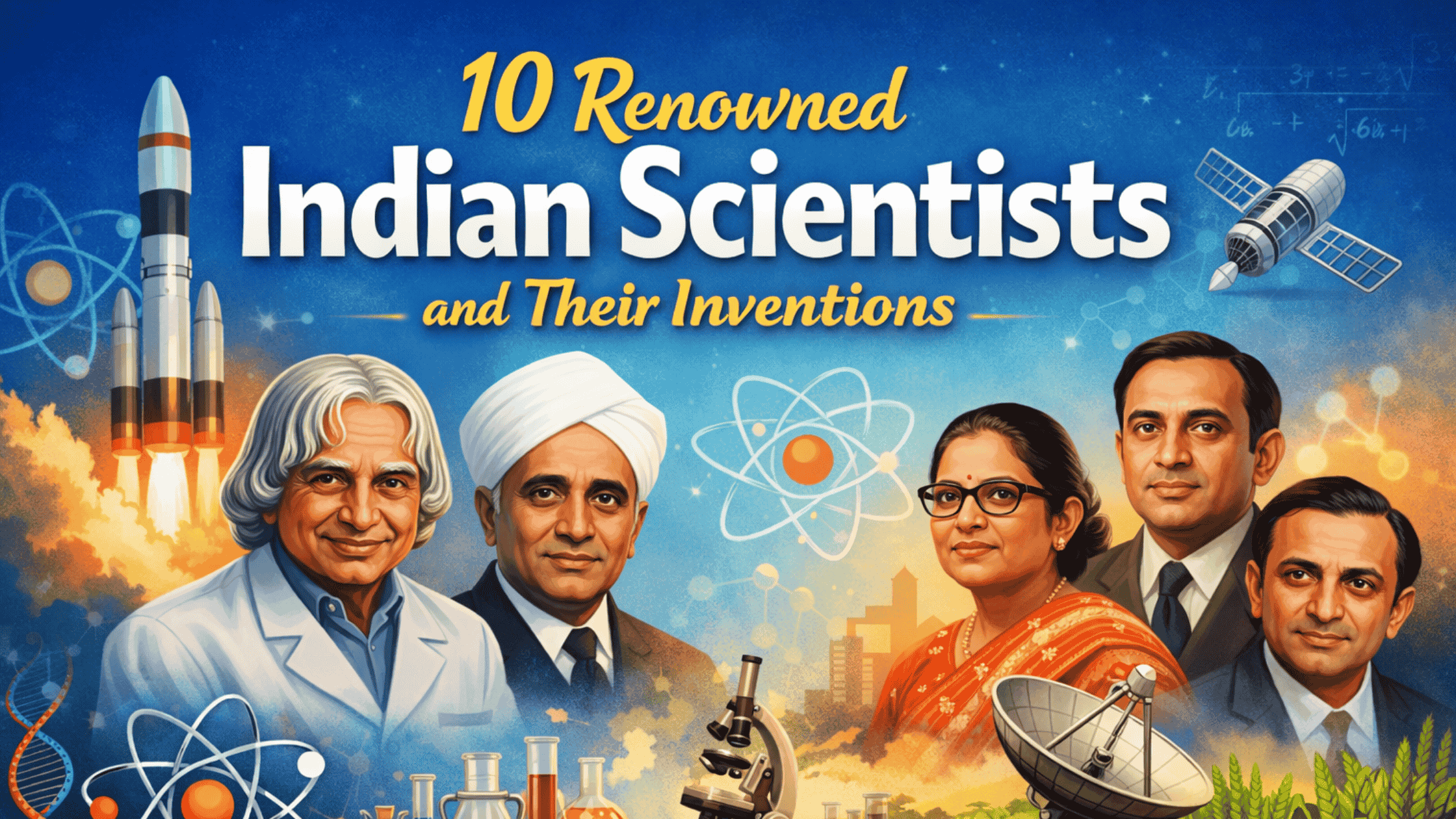
10 Renowned Indian Scientists and Their Inventions
India’s scientific legacy is rich with brilliant minds whose discoveries and innovations influenced global progress across physics, mathematics, chemistry, biology, and space science. These famous Indian scientists changed how we understand the world and applied scientific knowledge for humanity’s benefit.
List of Indian Scientists and Their Notable Inventions/Contributions
- C.V. Raman — Discovery of the Raman Effect
- Homi J. Bhabha — Foundation of India’s Nuclear Program
- A.P.J. Abdul Kalam — Space Launch Vehicles & Defence Missiles
- Vikram Sarabhai — Indian Space Programme Initiation
- Jagadish Chandra Bose — Crescograph for Plant Response
- Har Gobind Khorana — Genetic Code & Artificial Gene Synthesis
- Asima Chatterjee — Anti-malarial and Anti-epileptic Drugs
- Satyendra Nath Bose — Bose-Einstein Statistics
- Meghnad Saha — Saha Ionization Equation
- Samarendra Kumar Mitra — India’s First Analog Computer
1. C.V. Raman – Raman Effect
Sir Chandrasekhara Venkata Raman was a physicist whose discovery of what is now known as the Raman Effect earned him the Nobel Prize in Physics in 1930. This phenomenon explains how light scattered by a material shifts in wavelength, providing a powerful tool for molecular analysis used widely in chemistry, physics, materials science, and medicine.
2. Homi J. Bhabha – Father of India’s Nuclear Science
Dr. Homi Jehangir Bhabha was instrumental in establishing India’s nuclear research framework. He laid the foundation for the country’s atomic energy capabilities and led institutions that advanced quantum theory and nuclear physics in India.
3. A.P.J. Abdul Kalam – Missile Technology & Space Launch Vehicles
Affectionately known as the “Missile Man of India,” Dr. A.P.J. Abdul Kalam played a pivotal role in developing indigenous space launch vehicles and defence missile systems such as the Agni and Prithvi. His visionary leadership helped position India among space-faring nations.
4. Vikram Sarabhai – Indian Space Programme Pioneer
Vikram Sarabhai is known as the architect of India’s space programme. His efforts led to the establishment of the Indian Space Research Organization (ISRO) and India’s first satellite launch platforms, laying the groundwork for future space exploration and satellite technology.
5. Jagadish Chandra Bose – Crescograph and Plant Research
Dr. Jagadish Chandra Bose was a visionary scientist whose invention of the crescograph allowed the measurement of plant growth and responses to stimuli. His work bridged biology and physics and influenced future research in plant physiology.
6. Har Gobind Khorana – Genetic Code and Biochemistry
Dr. Har Gobind Khorana, a Nobel laureate in Physiology or Medicine, was a biochemist who helped decipher the genetic code and synthesized the first artificial gene. His work catalyzed advancements in molecular biology and biotechnology.
7. Asima Chatterjee – Life-Saving Medicinal Research
Dr. Asima Chatterjee was a pioneering organic chemist whose research led to the development of anti-epileptic and anti-malarial drugs derived from medicinal plants. Her work remains significant in medicinal chemistry.
8. Satyendra Nath Bose – Bose-Einstein Statistics
Professor Satyendra Nath Bose collaborated with Albert Einstein to develop Bose-Einstein statistics, a foundational concept in quantum mechanics. This work has had a lasting impact on theoretical physics and the study of quantum particles.
9. Meghnad Saha – Saha Ionization Equation
Meghnad Saha, an astrophysicist, formulated the Saha Ionization Equation, which explains how atoms ionize under different temperatures. This equation is vital for understanding stellar atmospheres and astrophysics.
10. Samarendra Kumar Mitra – First Indian Analog Computer
Samarendra Kumar Mitra was a pioneering scientist who designed and built India’s first analog computer in the early 1950s. His work laid an early foundation for computing technology in India, setting the stage for future developments in digital computing.
Conclusion
From breakthroughs in quantum physics to innovations in space, computing, and medicine, the achievements of these famous Indian scientists highlight India’s vast contributions to global science and technology. Their curiosity, creativity, and dedication to discovery have not only expanded human knowledge but also inspired future generations of innovators. Celebrating these scientific giants reminds us that bold ideas and the relentless pursuit of knowledge can truly reshape the world.